

MSCHE President Heather F. Perfetti Testifies on Reduced-credit Baccalaureate Degrees at Pennsylvania Senate Education Committee Hearing
On behalf of the Middle States Commission on Higher Education (MSCHE), President Heather F. Perfetti provided thought leadership through written and oral testimony for the Pennsylvania Senate Education Committee’s hearing on reduced-credit baccalaureate degrees on October 20, 2026.
Invited by State Senator Lynda Schlegel Culver, Majority Chair of the Pennsylvania Senate’s Education Committee, Heather explained our role as an institutional accreditor and responded to questions from Committee members.
Our Commission has long valued institutions’ exploration of credential models that best suit the needs of students and communities, and we continue to support innovative and impactful approaches to education.
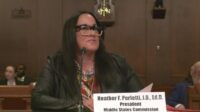
Heather provides oral testimony before responding to questions from the Pennsylvania Senate’s Education Committee.
“Our position is simply that for institutions in Pennsylvania accredited by our Commission, we do not offer barriers to reduced-credit-hour credentials,” Heather said. “However, we know and appreciated the concerns you may hear about this model, and we encourage you to work through them to remain student centered.”
As interest in innovative higher education models grow, Heather explained that we have been engaged on this issue, especially to illustrate how these credentials relate to accreditation standards, institutional autonomy, academic quality, and student learning.
“It was certainly important for us to lend to this discussion with the Commonwealth of Pennsylvania as we see the work that we do as critical partners to your constituents,” she said. “Because accreditation is often blamed as serving as a barrier to initiatives such as these, we wanted to share our position in the hope that it could be helpful.”
There is a misconception that accreditation prevents institutions from developing and offering these credentials. The Commission’s standards and policies permit institutions to develop and offer such credentials, provided they satisfy applicable expectations for quality, rigor, coherence, and student learning.
We are not prescriptive, and our accreditation allows for innovative, differently structured credentials, which do not require our prior approval. Our Commission is committed to working with our institutions interested in developing such credentials to present students with greater flexibility and more affordable program options. Already, we work with states to ensure quality and remain focused on the mission-centeredness of institutions as they advance innovative practices to serve students.
During the testimony, Heather offered “differently structured baccalaureate degrees” as a more precise description of these credentials, and Senator Carolyn Comitta expressed her appreciation for the naming convention compared to “reduced credit.” “I like that,” Carolyn said. “It’s very positive… leaving open the possibility that it could be a very positive outcome.”
Lynda described the Commission as “incredibly helpful” and thanked Heather for her testimony.
“We were absolutely thrilled when we were connected with the Middle States Commission,” Lynda said. “I’m sure we’ll be calling on you as we continue through this process.”
We are grateful for this opportunity to provide our Commission’s perspective, and for our institutions to contribute their voices regarding this important topic. Representatives of our institutions that provided testimony included the following:
- Kathy W. Humphrey, President, Carlow University (PA)
- Lance Kennedy-Phillips, Vice Provost for Planning, Assessment, and Institutional Research, The Pennsylvania State University
- Brenda Allen, President, Lincoln University (PA)
- Joseph J. McCarthy, Provost & Senior Vice Chancellor, University of Pittsburgh (PA)
- Jodi Levine Laufgraben, Vice Provost for Academic Programs and Institutional Effectiveness, Temple University (PA)
- Jonathan Green, President, Susquehanna University (PA)
As policymakers continue exploring innovative higher education approaches, we remain committed to serving as a trusted resource, consistent with our Future Forward strategic directions to drive thought leadership, public awareness and understanding, influence and engagement, and impactful innovation.
Resources
Pennsylvania State Board of Higher Education’s Three-Year Baccalaureate Task Force
Jobs for the Future (JFF) Three-Year Bachelor’s Degrees Report
RAND Reduced-Credit Bachelor’s Degrees in Ohio Report
Written Testimony from the Middle States Commission on Higher Education
Categories: Accreditation, Policy and Procedures